austria
Austria’s Shopping Streets Under the Footfall Microscope: Vienna Leads, but Many Prime Locations Are Losing Visitors
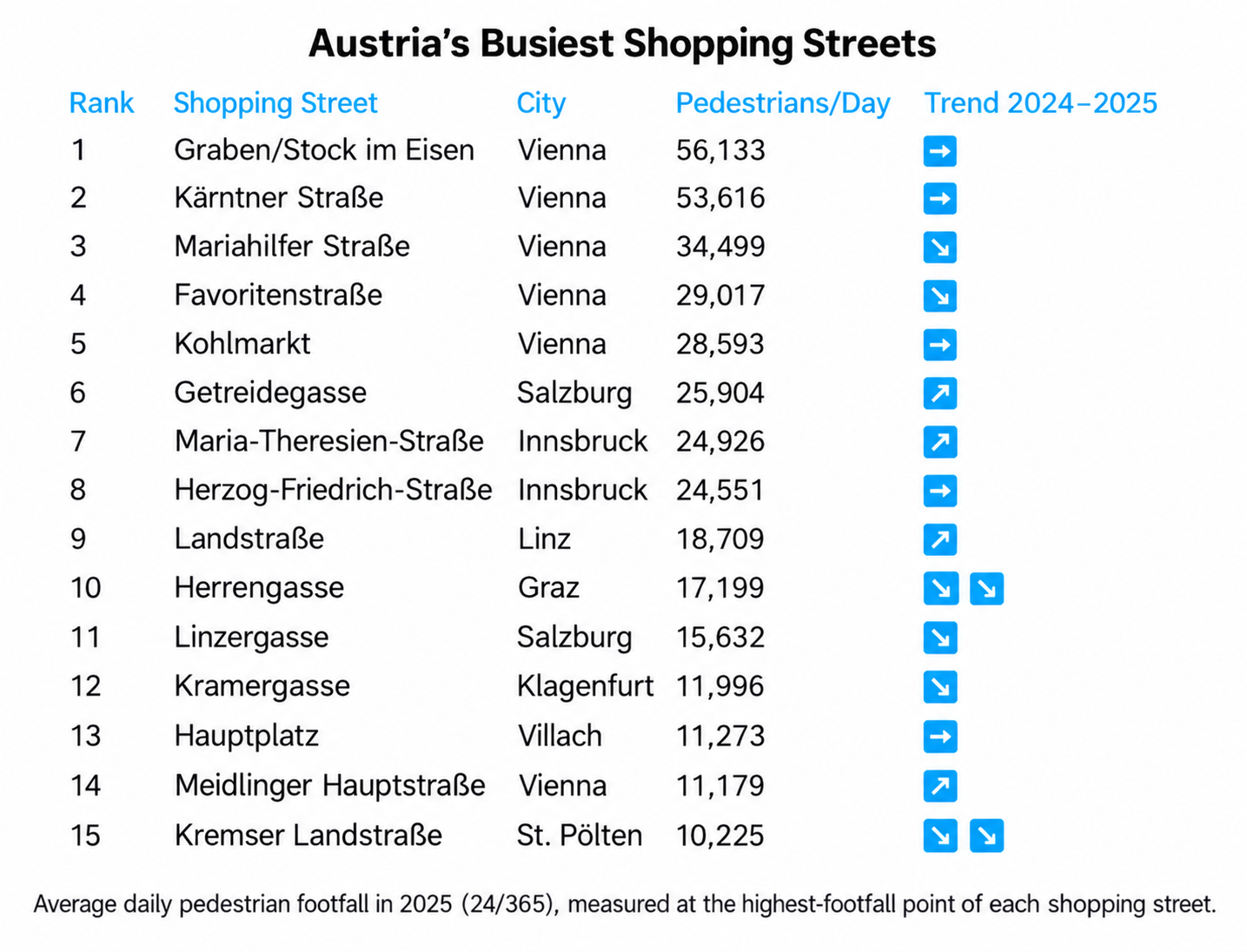
For the first time, precise, granular pedestrian footfall data is available for the whole of Austria. A new analysis by RegioData Research shows that Vienna’s Graben and Kärntner Straße are by far the country’s busiest shopping streets. While many tourism-driven prime locations are gaining or maintaining footfall, other established retail areas are increasingly under pressure from store closures. The decline is particularly pronounced in Graz
Vienna Leads: More Than 56,000 Pedestrians per Day
Austria’s highest pedestrian footfall by a clear margin is recorded at Vienna’s Graben, with around 56,000 people per day. Kärntner Straße follows with more than 53,000 daily pedestrians.
In third place is Mariahilfer Straße, with around 34,500 pedestrians per day. With tourists accounting for only 28% of its footfall, the street is considerably more dependent on local and regional visitors than the two leading locations. Nevertheless, almost 10,000 tourists visit Mariahilfer Straße every day in 2025. Compared with the previous year, however, the street recorded a decline in footfall of almost 9%. One possible reason is the large number of store closures in recent years, including well-known names such as Nike, Salamander, Gerry Weber, Benetton, Delka, Hallhuber and Promod.
A similar development can be seen on Vienna’s Favoritenstraße, which has also experienced declining footfall. With tourists accounting for just 8% of visitors, the street is particularly dependent on demand from its immediate catchment area.
Graz Under Pressure: Herrengasse Down Around 20%
The development in Graz is particularly striking. Both Herrengasse and Sackstraße recorded a significant decline in footfall of around 20% between 2024 and 2025, despite a slight increase in the share of tourists, which now stands at approximately 38%.
This development coincides with numerous store closures in Graz city centre. Well-known retail and hospitality businesses including H&M, Café Sacher, Benetton, Salamander, Orsay, Stiefelkönig and Manner have closed their locations. The loss of these established businesses is likely to be contributing significantly to the city centre becoming less attractive, particularly to visitors from the surrounding region. At the same time, 2024 also saw one-off effects that boosted footfall, including new openings and relocations such as the opening of the new Douglas store at Hauptplatz.
A similar trend can be observed on Kremser Landstraße in St. Pölten. Here too, store closures – including Benetton, Leonardo and Paolo – have changed the retail offering and are likely to have contributed to declining pedestrian footfall.
Tourism as a Footfall Driver: 77% of Kohlmarkt Visitors Come From Outside the Area
The extent to which tourism can influence pedestrian footfall is particularly evident on Vienna’s Kohlmarkt. 77% of pedestrians recorded there come from more than 50 kilometres away – the highest share among the shopping streets analysed. Salzburg’s Getreidegasse follows, with visitors from outside the area accounting for around 60%.
The analysis reveals a clear pattern: shopping streets with a high share of tourists tend to develop positively or at least maintain stable footfall levels. Vienna’s strongly tourism-oriented shopping streets in particular benefit from additional demand from international and other non-local visitors.
However, tourism is no guarantee of rising footfall. In Salzburg, individual shopping streets such as Linzergasse are experiencing declines despite the high proportion of non-local visitors.
Meidlinger Hauptstraße Shows That Local Retail Can Also Drive Footfall
Vienna’s Meidlinger Hauptstraße demonstrates that rising pedestrian footfall does not depend exclusively on tourism. Despite its low share of tourists, the shopping street has recorded positive development.
Key factors are likely to include the strengthening of the local retail and service offering as well as demographic changes within its catchment area. Meidlinger Hauptstraße therefore demonstrates that locally oriented shopping streets can also increase footfall when their offering is closely aligned with the needs of the local population.
Conclusion: Tourism Supports Prime Locations – but an Attractive Retail Mix Remains Crucial
The RegioData analysis reveals an overarching trend: even among Austria’s highest-footfall shopping streets, more locations tend to be affected by declining rather than increasing visitor numbers. Falling pedestrian footfall is particularly often associated with the closure of important stores and changes in the retail mix.
While tourism-oriented shopping streets frequently benefit from additional visitors, retail areas that primarily serve local customers face the challenge of maintaining their appeal to both residents and people from the wider catchment area.
Tourism alone, however, does not guarantee rising footfall, as the example of Salzburg demonstrates. Conversely, the positive development of Meidlinger Hauptstraße shows that growth is also possible outside Austria’s major tourist locations. The decisive factor remains an attractive and diverse retail mix that meets the needs of both the local population and visitors from the wider catchment area.
About the Study
Where in Austria are the most people actually on the move, and how is footfall developing in the country’s most important shopping streets? RegioData Research analysed Austria’s key retail zones and, for the first time, determined granular pedestrian footfall figures for the entire country.
The analysis is based on average daily pedestrian footfall across the entire year (24/365), measured at the highest-footfall point of each shopping street. The underlying data is provided by Targomo CASAFARI GmbH, Berlin. It enables detailed analyses of shopping streets, retail zones and individual locations, providing valuable insights for well-founded location and expansion decisions.
Further information: Pedestrian Footfall – RegioData Research
Share post