austria
Austria’s Foodservice Market: Rising Revenues – Fewer Outlets
Total revenue in Austria’s foodservice sector has increased by 56% over the past ten years, while the number of outlets has declined by 7%.
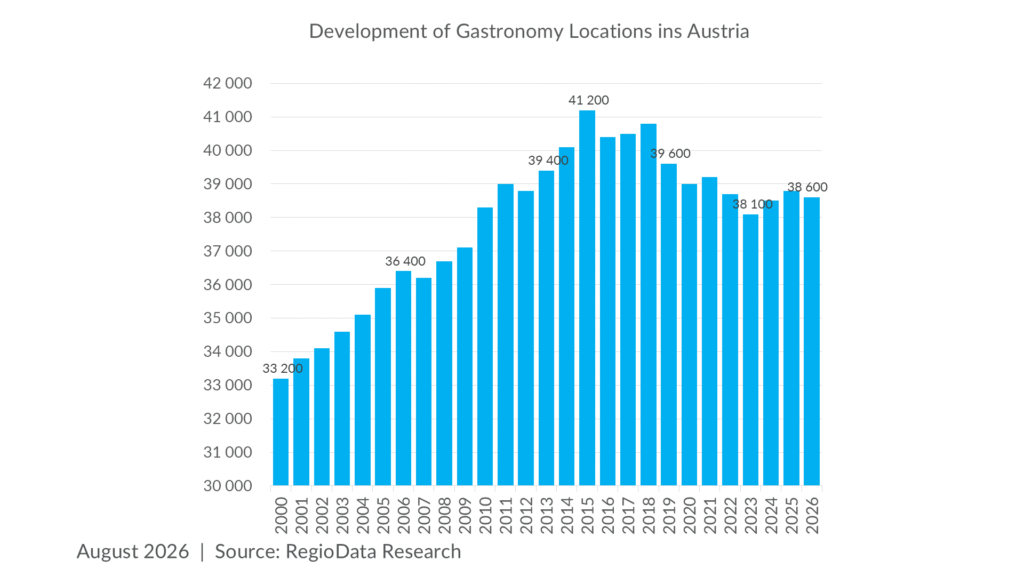
Austria’s foodservice landscape has been undergoing structural change for several years. Following a long period of growth, the number of foodservice outlets reached a historic peak of around 41,200 locations in 2015. By 2026, only approximately 38,600 foodservice outlets remain active across Austria.
Current analyses by RegioData Research also show that it is not only the number of outlets that is changing. The mix of foodservice concepts is shifting as well. Standardised processes, strong brands, high customer footfall and professional location decisions are playing an increasingly important role in the sector’s future development.
After Decades of Growth, the Market Enters a Consolidation Phase
Between 2000 and 2015, the number of foodservice outlets in Austria increased from around 33,200 to more than 41,000. This trend subsequently reversed, with a particularly noticeable decline since 2018. In 2023, the number fell to approximately 38,100 – the lowest level in more than a decade. A slight recovery followed in 2024 and 2025, with the total number of outlets reaching around 38,600 again in 2026.
This development illustrates that the industry is no longer in a phase of broad-based expansion – even though consumer spending by residents and tourists continues to increase. Instead, the market is undergoing a restructuring: businesses are disappearing, new concepts are emerging, and existing operators are adapting their formats. The slight increase currently being observed is primarily driven by small, “quick-service” concepts such as snack bars and takeaway outlets.
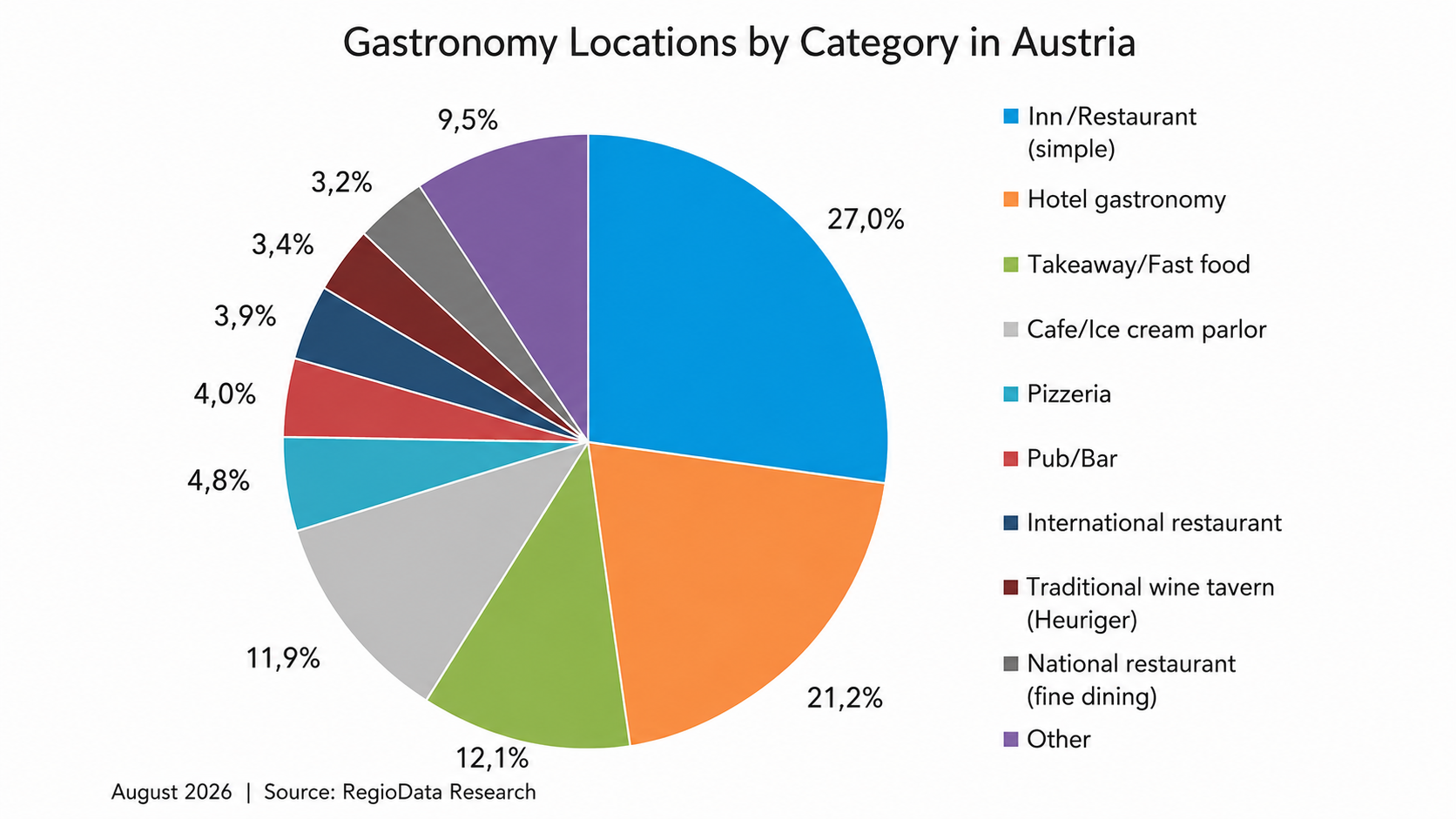
Almost One in Three Outlets Is a Traditional Restaurant or Inn
Despite the structural transformation, traditional restaurants and inns remain Austria’s largest foodservice category. Around 29% of all establishments fall into this segment.
Hotel restaurants rank second, accounting for 21.2%. Together, these two categories represent just over half of Austria’s total foodservice outlet stock. However, the remaining distribution demonstrates just how diverse the Austrian market has become.
Particularly noteworthy is the high share of snack-bar and fast-food concepts. At 12.1%, they already represent the third-largest individual category in the Austrian foodservice market.
System Catering Is Becoming a Key Competitive Factor
System catering should not be equated with fast food. It comprises foodservice concepts operating across multiple locations according to largely standardised guidelines. These include burger and pizza operators, coffee shops, bakery cafés, international restaurant chains, delivery concepts and, increasingly, higher-quality fast-casual restaurants.
The key advantage of these concepts lies in their standardisation. Purchasing, menus, food preparation, workforce planning, marketing and digital ordering processes can be organised centrally. This allows operators to open new locations more quickly and manage existing outlets more efficiently.
According to RegioData calculations, system catering companies currently operate around 1,100 locations in Austria, accounting for just under 3% of all foodservice outlets. In terms of revenue, however, operators such as McDonald’s, INTERSPAR restaurants and other system catering concepts account for almost 17% of the total market.
Growth Is Concentrated in High-Footfall Locations
System catering concepts are not expanding evenly across Austria. Locations combining high visitor footfall, good accessibility and suitable demand potential are particularly attractive. These include shopping centres and retail parks, railway stations and transport hubs, highly frequented city-centre locations and major tourist destinations.
Conclusion: Fewer Outlets, More Professional Competition
Austria continues to have a diverse foodservice landscape with strong regional roots. However, the number of outlets remains significantly below the peak recorded in 2015.
This does not mean that the market itself is shrinking – rather, it is becoming more selective. Concepts with clear positioning, efficient operations and suitable locations have strong growth prospects. System catering benefits from this development because it can combine standardised processes with professional expansion strategies.
The key transformation can therefore not simply be described as “chains replacing traditional restaurants”. Instead, Austria’s foodservice sector is evolving from a broadly expanding market into an increasingly professionalised competition for the best locations. Which operators ultimately succeed will depend more and more on how effectively their concept, target group and location fit together.
Share post