austria
Purchasing Power 2026: Strong Growth in Salzburg, Weaker Development in Carinthia and Vienna
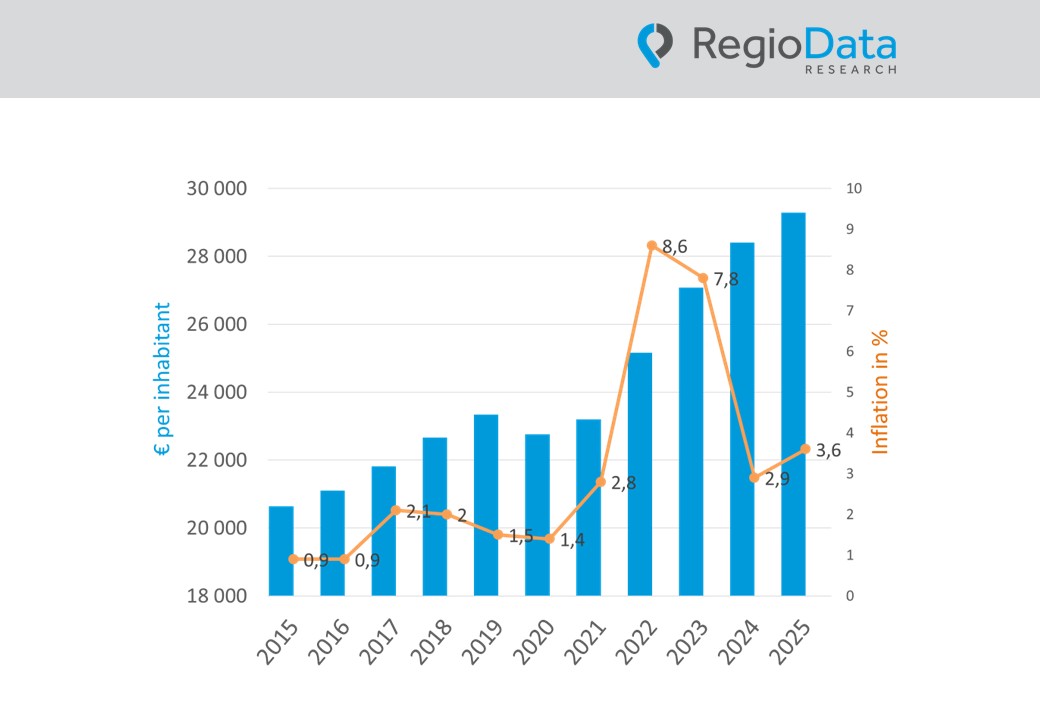
Average purchasing power in Austria will continue to show an overall positive trend in 2026. At the same time, long-term regional differences are shifting while economically strong regions maintain their high levels, rural areas in particular are experiencing above-average growth and are gradually catching up.
Federal States in Comparison 2026: Stable Ranking with Slight Convergence
Nominal purchasing power of the resident population has increased in all federal states in recent years, although differences in levels persist.
Salzburg ranks first with €30,954 per capita, followed by Lower Austria (€30,476) and Upper Austria (€29,669). Vorarlberg (€29,595) and Tyrol (€29,525) are also in the upper range.
The middle group includes Burgenland (€29,039) and Styria (€28,492), while Vienna (€28,239) and Carinthia (€27,987) remain below the national average.
Overall, economically stronger federal states continue to show higher purchasing power levels. At the same time, states with lower initial levels have caught up more strongly in recent years, leading to slight convergence—though clear differences remain.
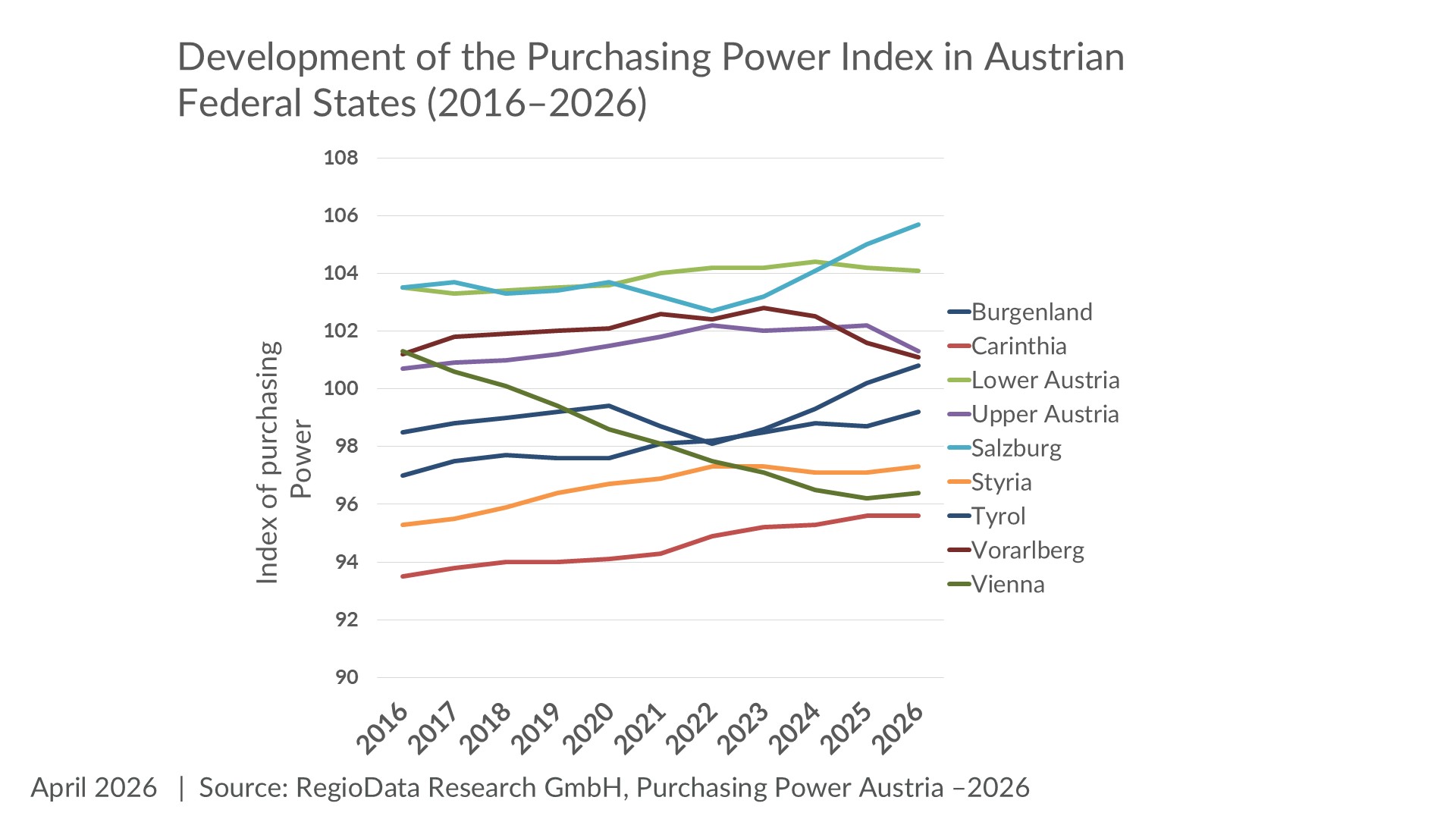
Long-Term Developments by Federal State (2016–2026)
Vienna’s development is particularly striking: the capital shows the strongest relative decline over the observed period, losing position compared to other states. Reasons include higher unemployment, an influx of lower-income population groups, and an increasing wave of retirements among the “boomer” generation.
In contrast, several federal states show above-average dynamic growth. Tyrol, Burgenland, and Carinthia stand out with the strongest gains in the long-term comparison. Salzburg has also performed very well and has regained the top position.
Overall, the trend indicates a slight shift in purchasing power dynamics: while western and southern states as well as structurally weaker regions are catching up, traditional centers like Vienna are losing relative momentum.
Differences become even more pronounced at the municipal level, where disparities remain extremely high.
“Top and Bottom Five” 2026: Significant Disparities Within Austria
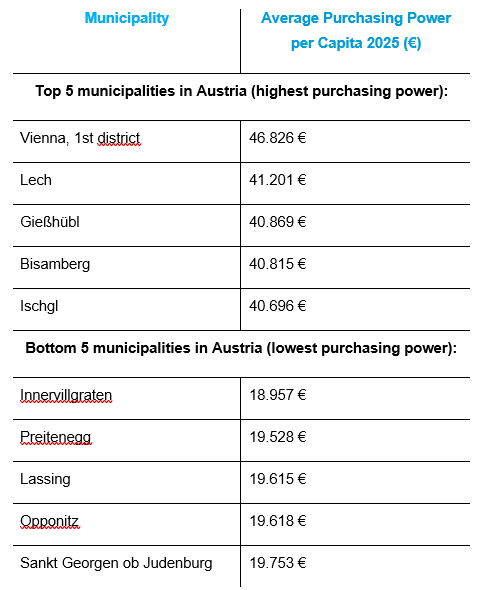
The analysis of the strongest and weakest municipalities highlights the wide range within Austria. At the municipal level, disparities in purchasing power are particularly evident.
The highest per capita value in 2026 is recorded in Vienna’s 1st district (€46,826), followed by Lech (€41,201), Gießhübl (€40,869), Bisamberg (€40,815), and Ischgl (€40,696). These municipalities benefit from strong economic structures and, especially in tourism and suburban areas, above-average incomes.
At the lower end of the ranking are mainly smaller, structurally weaker municipalities. Innervillgraten has the lowest purchasing power (€18,957), followed by Preitenegg (€19,528), Lassing (€19,615), Opponitz (€19,618), and Sankt Georgen ob Judenburg (€19,753).
Overall, the gap is substantial: there is a difference of around €28,000 per capita between the strongest and weakest municipalities. This highlights the persistent regional disparities within Austria.
Conclusion: Shifting Dynamics – Catch-Up Process Continues
Purchasing power in Austria continues to rise overall—though only modestly in the past year. However, regional development varies significantly.
While economically strong federal states largely maintain their high levels, several states and especially rural regions show above-average growth and are catching up in the long term.
Overall, the trend points toward a gradual convergence of regional purchasing power levels. Differences remain, but are increasingly offset by varying growth rates. The dynamics are thus shifting partly away from traditional centers toward other regions of Austria. While economically strong regions maintain their position, rural areas are gaining importance and gradually catching up with urban centers.
Share post