austria
Purchasing Power in Austria: Nominal Growth but Real Decline
The latest purchasing power analysis by RegioData Research shows that absolute purchasing power in Austria has reached €29,282 per capita, representing an increase of 3.1% compared to the previous year. Austria therefore remains positioned among the leading countries in Europe in terms of purchasing power. However, behind this positive overall figure lies a more nuanced picture: while nominal purchasing power continues to rise, real purchasing power shows no growth.
Development of Purchasing Power in Austria: A Long-Term Upward Trend
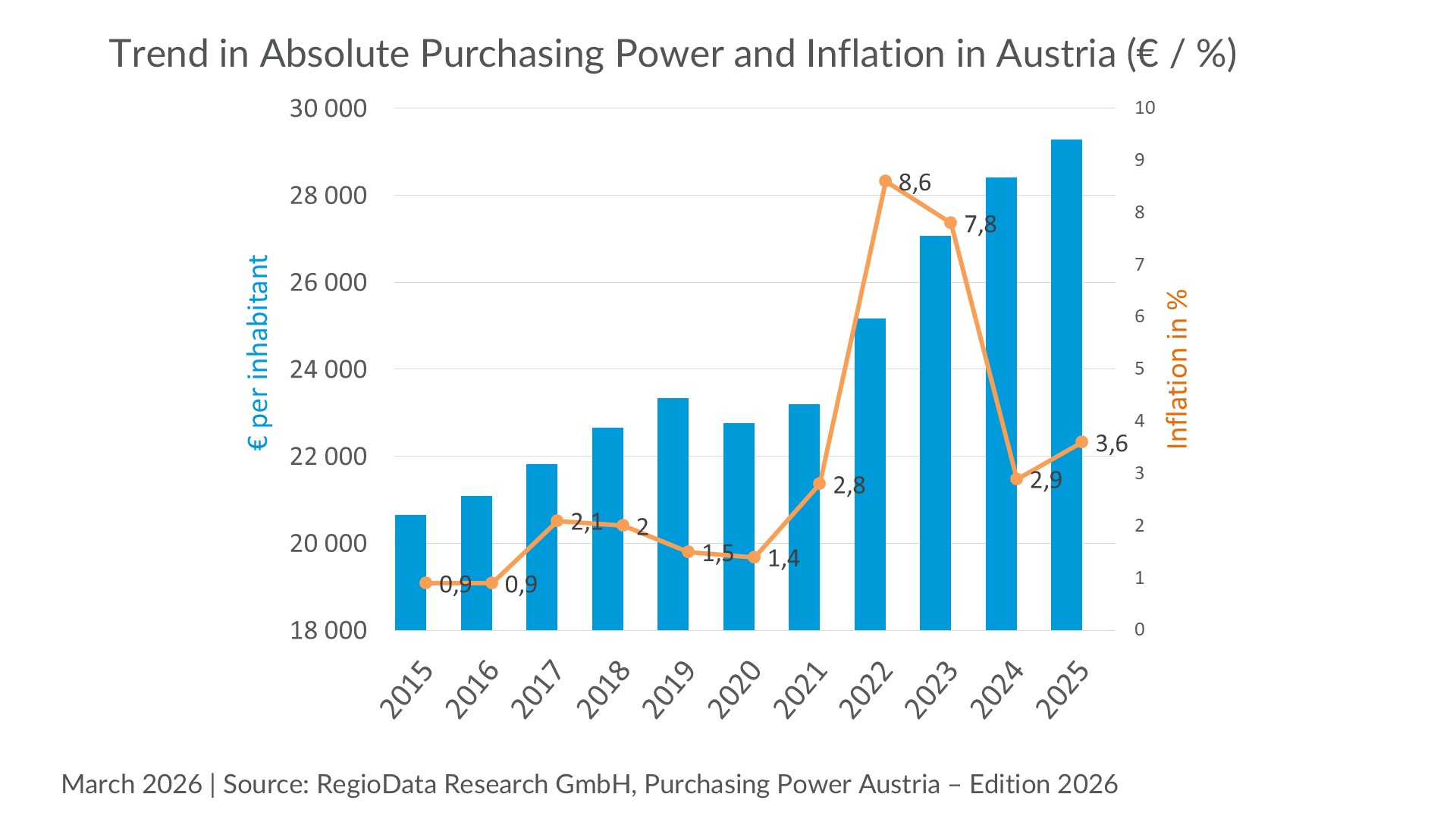
The long-term development shows a clear upward trend in purchasing power in Austria. Since 2016, the value has increased steadily. While in 2015 purchasing power amounted to €20,646 per capita, it has now reached a new nominal record level of €29,282. This represents an increase of €8,636, or around 42%, within ten years.
Compared with the previous year (€28,402), this corresponds to nominal growth of 3.1%. However, due to annual inflation of 3.6%, purchasing power has actually experienced a slight real decline when adjusted for inflation.
Following moderate growth until 2021, stronger nominal increases have been observed since 2023. However, these must be viewed in the context of the elevated inflation rates of recent years. While purchasing power has grown significantly in absolute terms, part of these gains has been offset by rising consumer prices.
Overall, the chart above therefore illustrates the long-term nominal increase in disposable income in Austria. At the same time, the higher inflation rates of recent years have reduced part of these gains in real terms.
Austria Maintains Its Position in the European Context
In a European comparison, Austria ranks 8th, remaining in the upper tier of countries with the highest purchasing power and clearly above the European average. Countries such as Switzerland, Luxembourg, and Denmark continue to record significantly higher per-capita values, while Austria ranks ahead of countries such as Italy and Spain.
At the same time, recent developments show that several Southeastern European countries have been recording higher growth rates over a longer period. These countries benefit from structural catching-up processes and rising incomes. Although Austria’s level remains significantly higher, the gap is gradually narrowing due to the stronger relative growth in these countries.
Within Western Europe, growth dynamics remain more moderate. Overall, differences in purchasing power across Europe remain considerable. Variations in the development of purchasing power at the international level illustrate that economic conditions and consumption opportunities vary significantly between countries.
In direct comparison with Germany, Austria continues to be at a very similar purchasing power level. Both countries rank in the upper segment within Europe and share comparable structural economic conditions. Both have also been affected in a similar way by the inflation developments of recent years, which has dampened real purchasing power growth in both countries. Switzerland, with €54,561 per capita, remains clearly at the top of the European ranking.
Nominal Growth – Real Development Remains Subdued
Developments in recent years highlight the growing divergence between nominal and real purchasing power. Since 2023, significant nominal increases have been observed, but these have been accompanied by strong price increases. In the past year, nominal purchasing power growth was ultimately below the inflation rate.
Purchasing power currently stands at a nominal record level per capita, having increased by 3.1% in 2025. However, consumer prices rose by 3.6% during the same period. After adjusting for inflation, this results in a slight real decline. Despite higher incomes in absolute terms, households therefore have slightly less real spending power available for consumption than in the previous year.
Purchasing power development thus remains positive in the long-term trend, but short-term real growth is subdued.
Conclusion: Long-Term Growth Amid Inflationary Pressure
Purchasing power in Austria has currently reached a nominal record level of €29,282 per capita. Over the past ten years, a clear upward trend can be observed. In the short term, however, real development is being slowed by rising prices. Growth remains below the inflation rate, resulting in a slight real decline.
In a European comparison, Austria continues to maintain its position in the upper tier. While the overall level remains high, several dynamically growing Southeastern European countries are currently recording stronger growth rates and gradually catching up in relative terms.
Share post